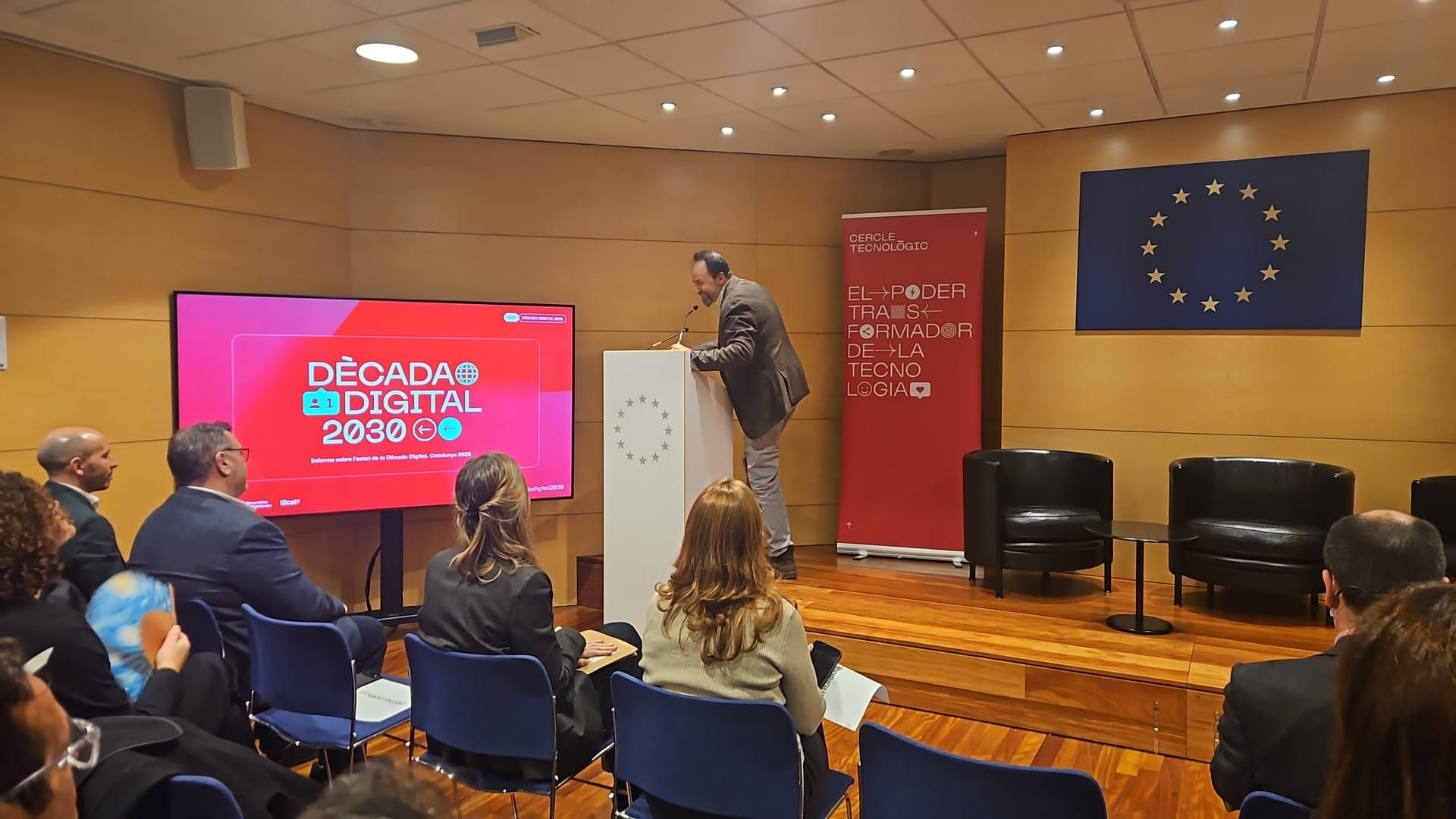
SIRTattended the presentation ofthe Report on the State of the Digital Decade 2030, an event organized by the Cercle Tecnològic that examined the progress made by Catalonia and the European Union toward the goals set for the digital transformation of the coming decade.
The event brought together institutional representatives, technology experts, and organizations from the digital ecosystem with the aim of evaluating, from a rigorous, data-driven perspective, Catalonia’s current standing within the framework of the European digitalization strategy.
The Digital Decade as a European Roadmap
The session opened with a keynote address byLaura Rahola, the European Commission’s representative in Barcelona, who framed theDigital Decade 2030as a common roadmap for all member states. In her remarks, she emphasized the need for coordinated progress in digital skills, infrastructure, business digitization, and digital public services.
Joan Ramon Barrera, president of the Cercle Tecnològic, then emphasized the importance of having clear and comparable indicators to guide public and private strategies. In an environment increasingly shaped by technology, the ability to measure progress becomes a key factor in decision-making.

Key Findings of the Report
The technical content of the report was presented byXavier Sellarès Faixat, director of the Cercle Tecnològic, who outlined the main findings of the analysis.
The document shows that Catalonia is performing strongly in terms of digitalization, with results above the European average for a very significant portion of the indicators evaluated.
Among other things, the report shows that Catalonia exceeds the European Union average in most of the metrics analyzed, including connectivity, technology adoption, and digital skills. It also highlights thesustained growth in employment related to ICT roles, which already account for a significant percentage of the labor market, as well as the high level of household connectivity.
In terms of digital skills, the study points to a positive trend in the proportion of the population with basic digital skills, bringing Catalonia increasingly closer to the goals set for 2030. These figures confirm a favorable trend, although they also highlightthe need to maintain the pace of investment, training, and technology adoption.
Digitization, Productivity, and Competitiveness
The day concluded with apanel discussion focused on the impact of digitization on productivity and economic competitiveness.
The debate addressed key issues such as the adoption of artificial intelligence in the business sector, the ability to attract and retain digital talent, and the transformation of the government toward more efficient and citizen-centered models.
It was emphasized that digitization is not merely a technological issue, but a structural factor that influences thecompetitiveness of regions. The availability of infrastructure, the population’s skill level, and the digital maturity of organizations are key determinants of sustainable economic growth.
SIRT's Vision
At SIRT, we follow these types of initiatives with particular attention because we share the conviction thatdigitalization is a strategic pillarfor economic and social development. A rigorous analysis of the state of the Digital Decade allows us to identify progress, but also to pinpoint areas for improvement in fields such as cybersecurity, the responsible adoption of emerging technologies, and the ongoing training of professionals.